
Decolonization in Africa: From Ghana to the Carnation Revolution
- Sep 13, 2025
- 4 min read
Updated: Sep 15, 2025
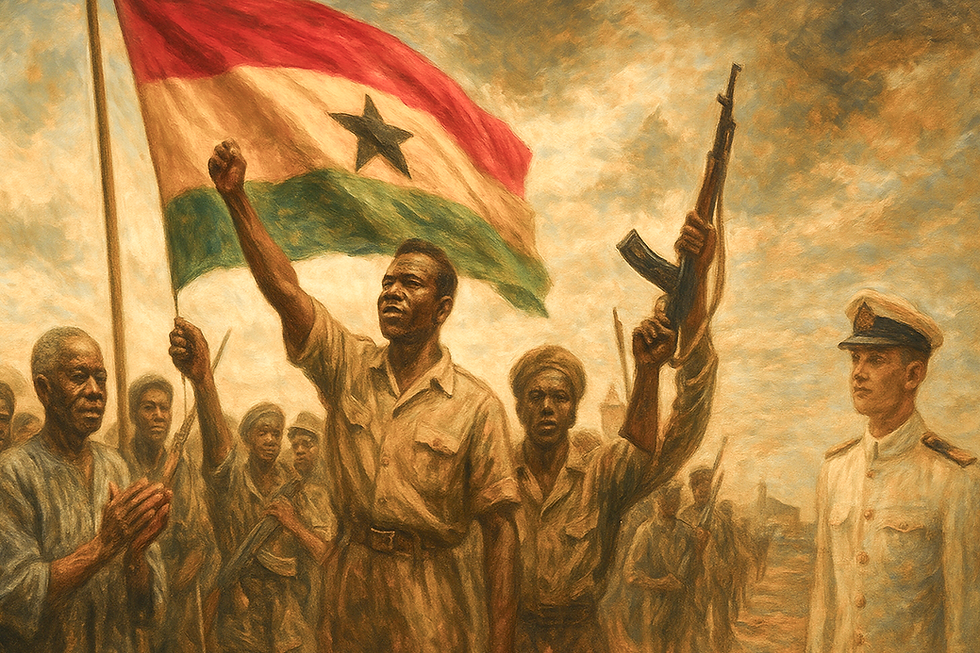
The 20th century was the century of African liberation. After centuries of colonial domination, exploitation, and cultural suppression, the winds of change swept across the continent, toppling European empires and giving birth to dozens of new nations. Beginning with Ghana’s independence in 1957 and culminating in the collapse of Portuguese colonial rule after the Carnation Revolution of 1974, Africa’s decolonization reshaped not only the continent but also global politics.
This article explores the story of decolonization in Africa, tracing its roots, examining the key movements and conflicts, and reflecting on the legacies that continue to shape the continent today.
The Colonial Map of Africa
At the dawn of the 20th century, Africa was almost entirely under European control. The “Scramble for Africa” of the late 19th century divided the continent between Britain, France, Belgium, Portugal, Germany, Spain, and Italy. Only Ethiopia and Liberia remained independent, though both faced external pressures. Colonial rule imposed artificial borders, extracted natural resources, and forced African populations into exploitative labor systems. Education and political participation were limited, while European powers sought to control every aspect of economic and cultural life. Yet beneath this domination, African leaders, intellectuals, and communities nurtured traditions of resistance that would later fuel independence movements.
The Roots of African Nationalism
The seeds of African nationalism were sown in the early 20th century. World War I and World War II brought African soldiers into European conflicts, exposing them to ideas of democracy and self-determination. Veterans returned home with new expectations and frustrations. At the same time, urbanization and education created new African elites who began to question colonial rule. Pan-African movements, led by figures like W.E.B. Du Bois and later Kwame Nkrumah, emphasized unity, pride, and independence. The founding of the United Nations in 1945, with its emphasis on self-determination, gave international legitimacy to anti-colonial struggles.
Ghana: The First Spark (1957)
The real turning point came in Ghana, formerly the British colony of the Gold Coast. Under the leadership of Kwame Nkrumah and his Convention People’s Party, Ghana pushed for independence through strikes, protests, and political organization. On March 6, 1957, Ghana became the first sub-Saharan African country to achieve independence. Nkrumah declared that “the independence of Ghana is meaningless unless it is linked up with the total liberation of the African continent.” His words inspired a wave of independence movements across Africa, proving that the colonial order could be dismantled.
The Wave of Independence (1960s)
The 1960s became known as the “Decade of Independence.” In 1960 alone, 17 African nations declared independence, including Nigeria, Senegal, and the Democratic Republic of Congo.
Some transitions were relatively peaceful. Britain and France, weakened by World War II, often negotiated independence, though they sought to maintain economic and cultural influence through the Commonwealth and the Francophonie. Other transitions were violent and bloody, particularly in regions where European settlers resisted change or where resources made colonies especially valuable.
The Algerian War of Independence
One of the most significant and brutal struggles occurred in Algeria, where the National Liberation Front (FLN) waged a guerrilla war against French rule from 1954 to 1962. The conflict involved torture, bombings, and atrocities on both sides, dividing French society and leading to the collapse of the Fourth Republic.
Algeria’s victory in 1962 was a watershed moment in African decolonization. It showed that determined resistance could defeat even one of Europe’s strongest colonial powers. But it also revealed the high human cost of liberation, as millions were displaced and tens of thousands killed.
Congo and the Challenge of Independence
The story of Congo illustrates another challenge of decolonization. Belgium abruptly granted independence in 1960, without preparing political institutions or leadership structures. Within days, the country descended into crisis. Prime Minister Patrice Lumumba was overthrown and assassinated, and Congo became a Cold War battleground. Congo’s turbulent independence highlighted the dangers of hasty withdrawal and the lingering influence of former colonial powers. It also revealed how decolonization in Africa was often entangled with global rivalries between the United States and the Soviet Union.
The Portuguese Empire and the Carnation Revolution
Portugal clung to its African colonies longer than any other European power. Under the dictatorship of António Salazar and later Marcelo Caetano, Lisbon refused to decolonize, insisting that Angola, Mozambique, and Guinea-Bissau were integral parts of Portugal itself. This led to long wars of liberation in the 1960s and 70s, with groups like MPLA (Angola), FRELIMO (Mozambique), and PAIGC (Guinea-Bissau) fighting protracted guerrilla wars against Portuguese forces. The conflicts drained Portugal economically and militarily.
In 1974, the Carnation Revolution, a peaceful military coup in Lisbon, overthrew the dictatorship. Within months, Portugal abandoned its colonies, granting independence to Angola, Mozambique, and Guinea-Bissau. This marked the final major chapter of decolonization in Africa, closing the era of European empires.
Legacies of Decolonization in Africa
The liberation of Africa brought pride, sovereignty, and the revival of cultural traditions. But it also left deep challenges:
Borders: Colonial boundaries often forced diverse ethnic groups into single states, fueling civil wars and separatist movements.
Economic Dependency: Many African economies remained reliant on exporting raw materials to former colonial powers, creating a form of neocolonialism.
Cold War Intrusion: African nations often became pawns in superpower rivalries, as seen in Congo, Angola, and Mozambique.
Cultural Renaissance: At the same time, independence sparked powerful movements in literature, music, and art. Writers like Chinua Achebe and musicians like Fela Kuti gave voice to new African identities.
From Ghana to Lisbon
Decolonization in Africa was one of the defining transformations of the 20th century. From Ghana’s hopeful independence in 1957 to the Carnation Revolution of 1974 that ended Portuguese rule, African peoples asserted their right to self-determination and reshaped the global order.
The journey was not easy — marked by wars, assassinations, economic struggles, and Cold War interference — but it was also a story of resilience, creativity, and the determination to reclaim dignity after centuries of empire. Today, Africa continues to wrestle with the legacies of colonialism, from economic challenges to political instability. Yet the achievements of decolonization remain undeniable: a continent once divided by European empires is now a mosaic of independent nations, each with its own story and its own future.

Comments